Address
E02 No.509 Floor 5 Unit3 Building1 No.1700 Tianfu Avenue North Section High-tech district Chengdu City Pilot Free Trade Zone China(Sichuan)
Work Hours
Monday to Friday: 9AM - 6PM
Weekend: 10AM - 5PM
Address
E02 No.509 Floor 5 Unit3 Building1 No.1700 Tianfu Avenue North Section High-tech district Chengdu City Pilot Free Trade Zone China(Sichuan)
Work Hours
Monday to Friday: 9AM - 6PM
Weekend: 10AM - 5PM


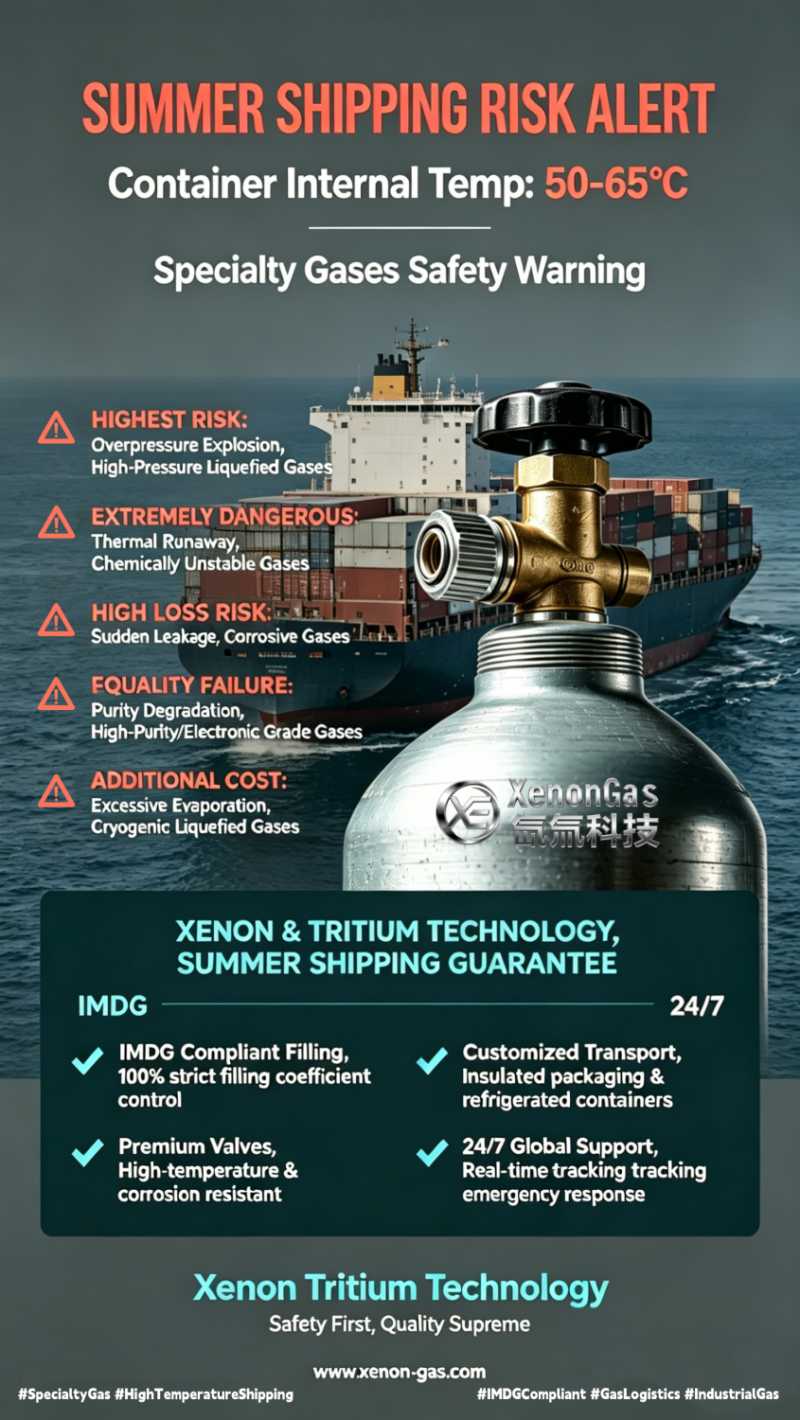
During the summer, the internal temperature of standard containers exposed to direct sunlight can reach 50-65°C, far exceeding normal temperatures and with significant day-night temperature differences. This period is prone to accidents, quality disputes, and cost losses in the export transportation of special gases. The following five types of gases are most severely affected and directly related to transportation safety and product delivery quality:
Additional loss: Low-temperature liquefied gases
Core issue: High temperatures significantly increase the evaporation rate, forcing forced pressure relief and emission, resulting in huge cost losses.
Typical gases: Liquid Argon, Liquid Nitrogen, Liquid Oxygen, Liquid Helium
Specific impact:
The evaporation rate of the low-temperature tank is 30%-50% higher than at normal temperatures, and the safety valve frequently pops to release gas. The loss of high-value liquid helium is particularly severe, with the single transportation loss possibly exceeding 10%, significantly increasing the customer’s procurement costs.
Xenon Tritium Technology – Summer High Temperature Sea Freight Exclusive Guarantee Plan
As a professional service provider specializing in special gases for 20 years, we have provided a fully customized solution for the risks of summer high-temperature sea freight:
✅ Strict compliance with regulations: 100% in accordance with IMDG international hazardous regulations, leaving sufficient space for thermal expansion
✅ High-end valves standard configuration: All models are equipped with Rodallex high-temperature and corrosion-resistant valves, with industry-leading sealing performance
✅ Customized transportation plan: Recommended insulation packaging and temperature-controlled refrigerated containers for gases with special characteristics, and mechanical refrigeration throughout for high-risk gases
✅ Optimal route planning: Avoiding high-temperature routes near the equator and extreme high-temperature periods, and prioritizing the selection of cool cargo stowage in the hold
✅ Full-process dynamic tracking: Real-time monitoring of transportation status, providing 7×24-hour emergency response and technical support
We always adhere to “Safety First, Quality Supreme”, providing safe, stable, and reliable cross-border transportation services for global customers.
Highest risk: High-pressure liquefied gases
Core issue: The saturated vapor pressure increases exponentially with temperature, easily causing the cylinder to overpressure and explode.
Typical gases: Ethylene Oxide (EO), Ammonia (NH₃), Sulfur Hexafluoride (SF₆), Carbon Dioxide, Propane, Butane
Specific impact:
Ethylene Oxide (boiling point 10.7°C): The pressure surges sharply at high temperatures, and it may also trigger dangerous self-polymerization reactions, releasing a large amount of heat and causing thermal runaway.
Sulfur Hexafluoride (critical temperature 45.5°C): The temperature inside the container in summer is highly likely to exceed its critical value. The liquid completely vaporizes into a supercritical fluid, and the pressure rises sharply with temperature. If the filling coefficient is not controlled properly, it is highly likely to cause the cylinder to overpressure and rupture.
If the filling coefficient exceeds the IMDG limit of 0.85 (the general limit for most high-pressure liquefied gases), the safety valve will frequently pop to release pressure, causing a large amount of gas loss and even triggering fire and explosion accidents.
Extremely dangerous: Gases with unstable chemical properties
Core issue: High temperatures accelerate decomposition, polymerization, or self-ignition reactions, easily triggering uncontrollable thermal runaway explosions.
Typical gases: Silicon Hydride (SiH₄), Boron Hydride (B₂H₆), Phosphine, Ethylene Oxide (see the first category)
Specific impact:
Silicon Hydride: The self-ignition point is extremely low (usually < -50°C). Even at room temperature or low temperatures, leakage can immediately self-ignite. In high-temperature weather, leakage will cause an explosive ignition. The risk increases exponentially.
Boron Hydride: High-temperature decomposition produces hydrogen gas and highly toxic boron compounds. The explosion limit is extremely wide, and it is highly likely to cause a secondary explosion.
All single-component gases undergo self-polymerization reactions, releasing a large amount of heat and creating a vicious cycle, ultimately causing the cylinder to burst.
High loss risk: Corrosive gases
Core issue: High temperatures significantly accelerate the corrosion rate, causing sudden failure and leakage of cylinders and valves.
Typical gases: Chlorine Hydride (HCl), Sulfur Dioxide (SO₂), Sulfur Hexafluoride (SF₆), Ammonia (NH₃)
Specific impact:
The adsorbed trace moisture and hydrocarbons on the inner wall of the cylinder and the sealing parts corrode, causing micro-leaks, resulting in high-value gas loss.
Ammonia (NH₃): It has strong corrosiveness to copper, zinc, etc. alloys; more dangerous is that in the presence of trace moisture, it will cause stress corrosion cracking (SCC) in carbon steel and low-alloy steel, leading to sudden failure and leakage of the cylinder without warning.
The corrosive gas released during leakage will contaminate the interior of the container, causing cross-contamination of subsequent goods, and generating a huge risk of compensation.
Accelerating the aging and failure of valve sealing parts, increasing the probability of sudden leakage during transportation.
Quality damage: High-purity / Electronic-grade gases
Core issue: High temperatures cause the release of trace impurities, directly damaging the purity and usability of the gas.
Typical gases: 5N/6N High-Purity Argon, High-Purity Nitrogen, Electronic-grade Specialty Gases, Standard Calibration Gas
Specific impact:
Trace moisture and hydrocarbons adsorbed on the inner wall of the cylinder are released at high temperatures, causing the purity of the gas to drop by 1-2 grades.
The composition concentration of the standard calibration gas group deviates, completely losing its calibration value, and cannot be used for instrument calibration.
It cannot meet the strict requirements of high-end customers such as semiconductors, precision laboratories, and medical equipment, directly resulting in customer rejection and claims.