Address
E02 No.509 Floor 5 Unit3 Building1 No.1700 Tianfu Avenue North Section High-tech district Chengdu City Pilot Free Trade Zone China(Sichuan)
Work Hours
Monday to Friday: 9AM - 6PM
Weekend: 10AM - 5PM
Address
E02 No.509 Floor 5 Unit3 Building1 No.1700 Tianfu Avenue North Section High-tech district Chengdu City Pilot Free Trade Zone China(Sichuan)
Work Hours
Monday to Friday: 9AM - 6PM
Weekend: 10AM - 5PM


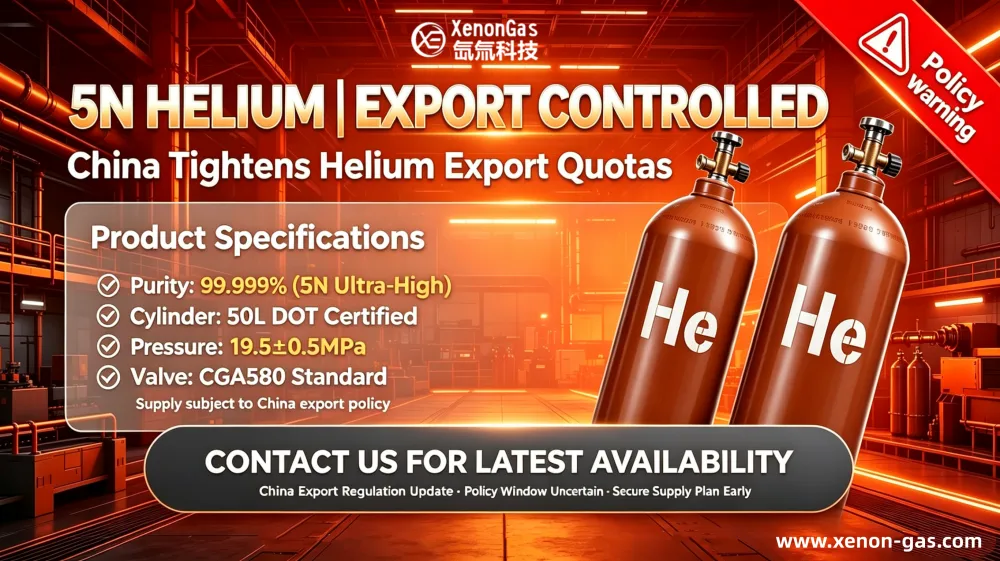
On July 10, 2026, China’s Ministry of Commerce and General Administration of Customs jointly issued an official announcement imposing a temporary export ban on helium gas under HS code 2804290010. The policy takes effect immediately with no fixed lifting date, and any further adjustments will be announced separately.
This regulatory measure is not an abrupt decision but a strategic response to the deteriorating global helium supply chain. Currently, the global helium market is highly oligopolistic, with over 85% of commercial helium production concentrated in the United States, Qatar, and Russia. Multiple supply-side crises have overlapped in recent years: major helium production facilities in Qatar remain impaired with a restoration cycle of several years; Russia continues to tighten helium export approvals and slash overseas quotas. The global helium market has long been in a tight balance characterized by insufficient supply, low inventory, and rising prices. As a non-renewable strategic rare gas, helium has no low-cost alternatives in advanced semiconductor manufacturing, medical MRI equipment, aerospace testing, and precision inspection. The core purpose of this export ban is to prioritize and secure the stability of domestic high-end manufacturing supply chains.
Most countries in Eastern Europe and Southeast Asia lack domestic helium extraction capacity and have long relied on cost-effective bottled high-purity helium to fill regional market gaps. Following the export ban, local gas distributors, laboratories, manufacturing enterprises, and supporting semiconductor factories are facing direct supply shortages. Global small and medium-sized buyers are forced to switch to long-term procurement from international leading gas suppliers, resulting in a 60%–120% increase in overall purchasing costs. A large number of regional enterprises have to reduce production scale, cut operational output, or suspend relevant experimental and manufacturing processes.
Global cross-border helium circulation has been restricted, and the stable cost-effective supply channel for global mid and small-sized buyers has been temporarily cut off. Regional purchasers in Eastern Europe and Southeast Asia will rapidly shift their supply chains to European and Middle Eastern sources, bringing irreversible restructuring of the global helium trade landscape. Excess domestic helium supplies previously intended for export will flow into the local market, intensifying domestic market competition and squeezing overall industry profit margins, while reducing the activity of global cross-border rare gas trade.
Based on the existing global supply shortage, China’s export restriction will further drive up spot prices for industrial-grade and electronic ultra-high-purity helium. Small and medium-sized wafer fabs, medical MRI service providers, and university superconducting research institutions worldwide will generally reduce helium consumption, cut operational budgets, and delay capacity expansion plans, pushing up marginal production costs for global high-end manufacturing industries.
Leading global resource enterprises will continue to tighten supply quotas for small and medium-sized distributors and raise spot prices, prioritizing supply for local clients and long-term contracted customers. The procurement space for global small-scale traders and end manufacturers will be continuously compressed. Global helium production capacity, pricing power, and core supply resources will further concentrate in the hands of top suppliers, strengthening the industry’s oligopolistic structure.
The era of completely free global trade in rare gases has come to an end. All major economies will prioritize domestic supply for strategic sectors including semiconductors, medical treatment, military industry, and advanced scientific research. Export restrictions, quota management, and national strategic reserves will become industry norms, driving the global supply chain toward regionalization and barrier segmentation.
The EU will accelerate the development of local helium resources and improve its strategic reserve system. Eastern European importing channels will gradually tilt toward Western European supply sources, and regional reliance on imported bottled helium will continue to decline in the long run.
China will comprehensively accelerate the construction of helium extraction projects based on LNG tail gas and coalbed methane. Local high-purity helium purification technology and helium recycling systems will be widely promoted, steadily improving domestic self-sufficiency rates. The industry development focus will fully shift from export-oriented growth to securing independent and controllable domestic high-end industrial supply chains.
Even if the export policy is lifted in the future, global overseas markets will have completed supply chain switching and resource integration with mature regional supply systems established. The previous cross-border helium trade share will be difficult to restore, and the global cost-effective helium circulation system will be permanently restructured.
⚠️ Short term: Global helium supply gaps will expand and market prices will continue rising. Small and medium-sized overseas end-users and distributors will bear the brunt of supply shortages and cost pressures, while domestic export business is temporarily suspended and market competition intensifies. ⚠️ Long term: The global helium supply chain will undergo comprehensive restructuring with prominent regional trade barriers. China’s helium industry will enter a new stage centered on independent technological breakthroughs and domestic supply security.