Address
E02 No.509 Floor 5 Unit3 Building1 No.1700 Tianfu Avenue North Section High-tech district Chengdu City Pilot Free Trade Zone China(Sichuan)
Work Hours
Monday to Friday: 9AM - 6PM
Weekend: 10AM - 5PM
Address
E02 No.509 Floor 5 Unit3 Building1 No.1700 Tianfu Avenue North Section High-tech district Chengdu City Pilot Free Trade Zone China(Sichuan)
Work Hours
Monday to Friday: 9AM - 6PM
Weekend: 10AM - 5PM


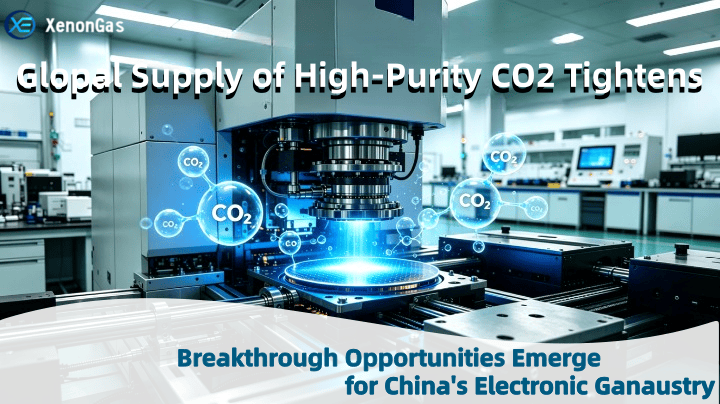
The global semiconductor manufacturing industry faces a structural supply-demand imbalance. After helium and fluorine-based specialty gases, 6N–7N ultra-high-purity CO₂ for advanced chip manufacturing has become another core consumable with medium-to-long-term structural supply shortages. Multiple industry institutions forecast the global supply shortfall of this material will reach 12%–15% by 2026.
The global semiconductor manufacturing industry faces a structural supply-demand imbalance. After helium and fluorine-based specialty gases, 6N–7N ultra-high-purity CO₂ for advanced chip manufacturing has become another core consumable with medium-to-long-term structural supply shortages. Multiple industry institutions forecast the global supply shortfall of this material will reach 12%–15% by 2026. Traditional gas source output has shrunk, cross-border delivery cycles have extended, and regional spot prices have kept climbing. The long-standing oligopolistic supply landscape in overseas markets has been disrupted, triggering supply chain restructuring and creating new growth opportunities for global electronic specialty gas manufacturers.
1.There is a long-term and structural imbalance between supply and demand.
Ultra-high-purity CO₂ is an indispensable specialty material in the chip manufacturing process, mainly used in the supercritical carbon dioxide cleaning procedures of 7–28nm logic chips, HBM (High-Bandwidth Memory), and 3D NAND flash memory. It directly affects the wafer yield and process stability. Currently, there is no substitute material with matching performance. Multiple global industrial research institutes forecast that by 2026, the global supply shortfall of 6N/7N ultra-high-purity CO₂ tailored for advanced processes will hit 12%–15%. This round of supply shortage stems from the underlying structural contradictions in the industry, rather than short-term seasonal fluctuations.
2.Supply side: The gas sources in traditional production areas continue to shrink.
The core reason for the tightening of the supply side is the continuous reduction of global high-end and high-quality raw gas sources. The mainstream production path for semiconductor-grade high-purity CO₂ mainly involves the recovery and purification of hydrogen tail gas from petrochemicals, refining, and hydrogen production. The pure chemical synthesis route is costly and has weak controllability of impurities, rendering it unviable for mass commercial production. The production process adopts multi-stage precision distillation combined with catalytic oxidation and molecular sieve adsorption purification techniques, along with a fully enclosed and clean storage and transportation system. It targets the control of trace impurities such as hydrogen, oxygen and argon mixtures, nitrogen, carbon monoxide, methane, and moisture at different levels. Taking 6N grade (purity ≥ 99.9999%) products as an example, the concentration limit for each single impurity is controlled between 0.01 ppm and 0.17 ppm. For 7N products, the purity is ≥ 99.99999%, and allowable limits of individual impurities are further tightened down to the ppb range. In recent years, capacity utilization rates of chemical facilities in core traditional semiconductor manufacturing hubs including Europe and South Korea have continued to decline, and the supply of high-quality and stable tail gas sources has continued to decrease. The effective production capacity of high-end and high-purity CO₂ suitable for export and compatible with advanced manufacturing processes has also shrunk simultaneously worldwide.
3.The rigid expansion at the demand end amplifies the risks in the supply chain.
The demand side maintains a rigid expansion trend. New production lines for advanced logic and high-end storage have been put into operation in various parts of the world. In addition, major wafer factories have increased pre-stocking and strengthened long-term purchase agreements due to supply chain risk control. As a result, the supply-demand gap has further widened. Currently, inventory levels of high-purity CO₂ held by leading European and South Korean wafer fabs have dropped below the industry’s standard one-month safety stock threshold. Spot prices across the Asia-Pacific, Japan and South Korea have surged over 20% year-on-year. The extended supply chain cycle, frequent supply fluctuations, and continuous rising procurement costs have fully exposed the current vulnerability of the global semiconductor material supply chain in terms of risk resistance.
4.The traditional monopoly model has laid the groundwork for potential centralization risks.
For a long time, the global high-end high-purity CO₂ market has been highly concentrated. A few international established gas companies, relying on their pioneering technologies, long-term customer qualification barriers, and their own stable gas source resources, have occupied the vast majority of the market share. The gas source procurement channels for global wafer factories are relatively single, and supply chain concentration risks remain acute.
The global gas supply is continuously tight, and wafer factories urgently need multiple backup gas sources. Xenon Tritium semiconductor-grade ultra-high-purity CO₂ is suitable for 7–28nm chips, HBM, and 3D NAND cleaning processes. As a stable alternative gas source, it can mitigate risks including single overseas supplier outages, price surges and shipment delays.
Supply chain diversification and globalization have become irreversible industry trends. Xenon Tritium, with its stable production capacity, ultra-high purity standards, and global delivery capabilities, is a high-quality partner for optimizing the gas source structure of global wafer factories and ensuring the continuous operation of production lines.