Address
E02 No.509 Floor 5 Unit3 Building1 No.1700 Tianfu Avenue North Section High-tech district Chengdu City Pilot Free Trade Zone China(Sichuan)
Work Hours
Monday to Friday: 9AM - 6PM
Weekend: 10AM - 5PM
Address
E02 No.509 Floor 5 Unit3 Building1 No.1700 Tianfu Avenue North Section High-tech district Chengdu City Pilot Free Trade Zone China(Sichuan)
Work Hours
Monday to Friday: 9AM - 6PM
Weekend: 10AM - 5PM


Keywords: High-purity Silane, Electronic-Grade Silane, Semiconductor Silane, Global Specialty Gas Supply Chain, Silane Export Price Trend
Global market analysts have long judged silane market trends based on production and purification capacity. However, the global high-purity silane export market in 2026 presents a typical structural supply mismatch. While China’s overall silane production and high-end purification capacity is sufficient to meet global market demand, certified large-volume export packaging equipment has become the core bottleneck restricting international delivery and pushing up spot prices.
Silane (SiH₄, UN2203, CAS 7803-62-5) is a highly pyrophoric, flammable industrial specialty gas. As an essential chemical precursor, it is widely applied in commercial semiconductor thin-film deposition, N-type photovoltaic cell passivation, and silicon-carbon anode manufacturing for lithium-ion batteries. Unlike small-cylinder domestic distribution, all cross-border silane exports strictly adopt standardized large-volume professional containers. The heavy-asset attributes, high compliance thresholds, and lengthy cross-border turnover cycles of export packaging are reshaping global silane supply rhythms and commercial pricing rules throughout 2026.
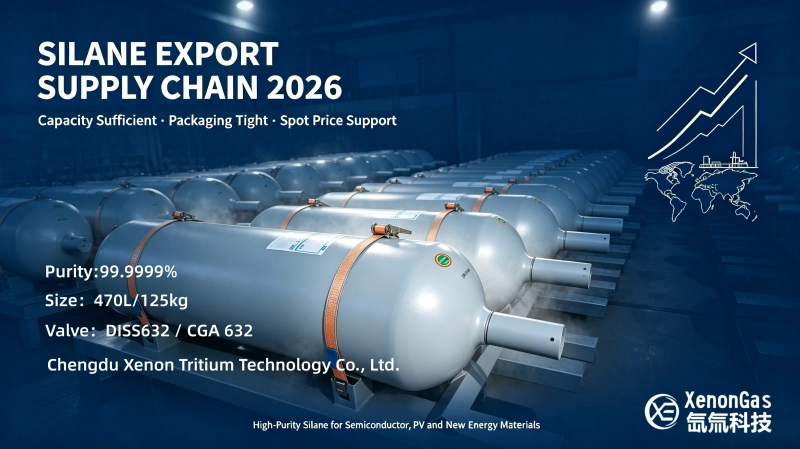
Based on SEMI official statistics, public disclosure data of listed manufacturers, and third-party global specialty gas industry research, the current silane market shows clear structural differentiation between total production capacity and actual exportable spot supply:
1.1 Production Capacity Status
Leading Chinese manufacturers have achieved stable mass production of 5N/6N PV-grade and electronic-grade silane, while 7N ultra-high-purity semiconductor-grade silane has realized large-scale domestic commercial substitution. Overall synthesis and high-purity purification capacity fully covers global downstream commercial demand, with no traditional production shortage.
1.2 Overseas Demand Drivers
The global civilian new energy and commercial semiconductor sectors maintain steady expansion. The rapid iteration of N-type TOPCon and HJT photovoltaic technologies continues to raise silane consumption for advanced surface passivation. The scaled mass production of 12-inch memory chips, commercial power semiconductors, and consumer AI logic chips sustains rigid procurement demand for 6N–7N ultra-high-purity silane. Furthermore, the large-scale commercialization of silicon-carbon anode materials has further expanded global market increment.
1.3 Market Structural Differentiation
PV-grade silane maintains relatively sufficient supply for general commercial use, while ultra-high-purity semiconductor-grade silane remains structurally tight. Strict process certification, ultra-precise purity control standards, and long-term fab qualification verification form a stable structural premium for high-end electronic-grade products used in civilian high-end manufacturing.
Core Industry Verdict: The current global silane supply contradiction does not stem from insufficient production capacity, but from limited cross-border delivery capacity caused by tightened export packaging resource turnover.
As a pyrophoric hazardous gas, silane complies with strict IMDG international transportation and packaging specifications. Small 40L cylinders are neither compliant nor cost-effective for cross-border maritime shipping. All formal global export orders adopt two standardized large-volume packaging solutions tailored for international trade:
2.1 440L Y-Type Large Export Cylinder
With a standard filling capacity of 120–125kg per cylinder, equipped with professional DISS632 (CGA 632) high-purity valves and DOT/ISO certified sealing systems. This packaging serves as the mainstream solution for global small-batch orders, overseas process validation sampling, and stable supply for medium-sized civilian production lines.
2.2 Tube Bundle Container (Torpedo Tank)
Compatible with standard 20ft/40ft maritime containers, each tube bundle container holds 3 to 4.2 tons of high-purity silane. It is exclusively applied for long-term framework orders from global wafer fabs and large-scale photovoltaic manufacturing bases, acting as the core carrier for bulk silane export.
Both export-specific container types feature heavy fixed-asset investment, strict global compliance certification, and long cross-border turnover cycles, forming the fundamental supply constraint in the current export market:
High Capital Investment Threshold: Export-grade large-volume containers, high-purity valve assemblies, and specialized sealing components require substantial upfront capital investment. Regular mandatory hydrostatic testing, airtightness calibration, annual compliance audits, and scheduled retirement renewal continuously consume operational funds with no short-term return.
Ultra-Long Cross-Border Turnover Cycle: The full export workflow includes gas filling, commodity inspection, customs declaration, ocean freight, overseas unloading, empty container return, nitrogen purging, purity reverification, and secondary refilling. The complete international turnover cycle is far longer than domestic circulation, limiting annual container turnover frequency and eliminating flexible incremental spot supply capacity.
Conservative Manufacturer Asset Expansion Strategy: As global specialty gas industry profit margins return to rational commercial levels, mainstream silane producers have suspended large-scale investment in new export container assets. Manufacturers prioritize optimizing existing container inventory to control operational risks and fixed-cost pressure.
Under this industry mechanism, suppliers implement clear customer prioritization: limited large-volume export containers are preferentially allocated to long-term framework clients with stable shipment schedules and reliable payment records. Ad-hoc spot inquiries and fluctuating small-batch orders face delayed scheduling and tighter delivery terms, directly reducing global spot market liquidity and providing sustained upward support for short-term export prices. In recent months, Y-cylinder packaged PV-grade silane spot prices have trended noticeably higher, reflecting tightening availability of immediately deliverable export packaging resources.
3.1 5N PV-Grade High-Purity Silane
Major overseas photovoltaic manufacturers mainly rely on annual long-term procurement agreements with fixed shipment schedules. Existing large-volume packaging resources sufficiently cover routine commercial delivery demands, ensuring stable overall supply. Seasonal centralized stocking cycles usually trigger temporary packaging turnover tension and mild spot price increases.
3.2 6N/7N Semiconductor Ultra-High-Purity Silane
Restricted by dual barriers of limited certified export packaging and ultra-rigorous purification & quality control standards, high-end semiconductor-grade silane resources are strictly allocated. Manufacturers prioritize qualified production capacity and certified export containers for established global commercial wafer fabs and power semiconductor manufacturers. Scattered overseas buyers face extremely limited spot availability, longer lead times, and strong price resilience, maintaining a stable high-end premium in global civilian semiconductor supply chains.
All global silane export operations strictly adhere to authoritative international regulatory and safety standards to ensure full cross-border compliance:
These mandatory compliance requirements, combined with the heavy-asset nature of export packaging, further limit spot supply flexibility and emphasize the value of cooperating with fully qualified export suppliers.
Facing the ongoing global shortage of certified silane export packaging and tightening spot supply, overseas manufacturing enterprises can effectively mitigate supply chain and cost risks through optimized procurement strategies:
Secure Long-Term Framework Agreements: Sign quarterly or annual fixed-volume delivery contracts to secure allocated quotas of large-volume Y-cylinders and tube bundle containers, obtaining priority scheduling and shipment rights to hedge spot price volatility.
Verify Comprehensive Export Competency: Beyond unit price comparison, evaluate suppliers’ self-owned export packaging reserves, standardized cross-border turnover systems, and professional empty container operation and maintenance capabilities — core indicators of stable and compliant delivery.
Advance Procurement Planning: Silane’s cross-border shipping and container return cycle is inherently lengthy. Emergency ad-hoc orders carry high risks of delivery delays. Overseas clients are recommended to lock production and shipment schedules 1–2 months in advance.
Adhere to Fully Compliant Export Delivery: All silane export shipments strictly follow IMDG international dangerous goods regulations. Formal commercial batches are fully equipped with standardized SDS documents, batch-specific COA purity inspection reports, and complete customs declaration files to ensure smooth global customs clearance and consistent production-line safety.
Chengdu Xenon Tritium Technology Co., Ltd. is a professional global specialty gas export supplier focused on serving civilian semiconductor, photovoltaic, and new energy manufacturing clients worldwide. Against the backdrop of global silane export packaging resource constraints, we leverage stable upstream production partnerships and a self-owned full set of certified large-volume export packaging systems to provide consistent supply of 5N–7N full-grade high-purity silane.
We deliver flexible, customized global export solutions, including 440L Y-cylinder small-batch commercial shipments and tube bundle container bulk maritime transportation. All export operations strictly comply with IMDG Code P200 and ANSI/CGA G-13 industry standards. Supported by full-process purity traceability, internationally compliant export documentation, professional cross-border logistics, and full-lifecycle technical support, we help global clients effectively avoid packaging shortages, delivery fluctuations, and spot price risks, ensuring stable long-term operation of civilian high-end manufacturing lines.
In the long term, global silane price trends will be determined by the balance between newly added certified export container capacity and fluctuations in overseas downstream commercial demand. In the short term, constrained by heavy-asset packaging limitations, slow container turnover efficiency, and long-term client priority allocation mechanisms, global silane spot liquidity will remain tight, with clear upward price support.
For global procurement enterprises, shifting from ad-hoc spot purchasing to long-term framework cooperation and resource locking has become the core strategy to stabilize procurement costs and sustain continuous production throughout 2026.
Q: Is the current rise in global silane prices caused by insufficient production capacity?
A: No. Current global silane synthesis and high-purity purification capacity fully meets international commercial demand. The core constraint lies in limited quantities and slow turnover of IMDG-certified large-volume export containers. Manufacturers’ prudent heavy-asset investment strategies reduce available spot export supply.
Q: Why are small cylinders not used for international silane exports?
A: In accordance with IMDG international dangerous goods regulations and global maritime commercial cost standards, small cylinders fail to meet compliance and cost-efficiency requirements for formal cross-border trade. All standardized global silane exports adopt certified large-volume container solutions.
Q: Is semiconductor-grade silane supply tighter than PV-grade globally?
A: Yes. Ultra-high-purity semiconductor-grade silane is restricted by dual barriers of limited certified export packaging and stringent industrial process certification and quality control standards. It features scarcer spot supply, longer delivery lead times, and stronger price resilience in the international market.
Disclaimer: This article is compiled based on 2026 global specialty gas industry research, public data from listed manufacturers, and official IMDG international dangerous goods transportation specifications. It serves only as objective global supply chain trend analysis and commercial reference, without mandatory price forecasting or trading guidance. Packaging reserves, turnover efficiency, and delivery cycles vary by supplier. Final quotations and delivery arrangements are subject to official commercial confirmation.
Chengdu Xenon Tritium Technology Co., Ltd. Professional Global Specialty Gas Export Supplier