Address
E02 No.509 Floor 5 Unit3 Building1 No.1700 Tianfu Avenue North Section High-tech district Chengdu City Pilot Free Trade Zone China(Sichuan)
Work Hours
Monday to Friday: 9AM - 6PM
Weekend: 10AM - 5PM
Address
E02 No.509 Floor 5 Unit3 Building1 No.1700 Tianfu Avenue North Section High-tech district Chengdu City Pilot Free Trade Zone China(Sichuan)
Work Hours
Monday to Friday: 9AM - 6PM
Weekend: 10AM - 5PM


In 2026, neon gas is no longer a vulnerable link amid geopolitical conflicts, but has evolved into a resilient symbol of the global semiconductor industrial ecosystem. Supply will no longer rely on a single source, demand will no longer respond passively, and technology will no longer break through in isolation — the recycling loop, policy coordination, process optimization and material innovation are jointly building a stable ecosystem without central dependency.
Core Conclusion: System resilience stems from multi-dimensional synergy.
In 2026, neon gas is no longer a vulnerable link amid geopolitical conflicts, but has evolved into a resilient symbol of the global semiconductor industrial ecosystem. Supply will no longer rely on a single source, demand will no longer respond passively, and technology will no longer break through in isolation — the recycling loop, policy coordination, process optimization and material innovation are jointly building a stable ecosystem without central dependency.
The focus of the industry is no longer “Can neon gas be obtained?”, but “How to maximize the single service cycle of gas cylinders and reduce the overall gas usage cost?”
| Operator | Technical Route | Recycling Rate | Core Outcomes |
|---|---|---|---|
| Advanced wafer fabs | Modular exhaust gas capture + Low-temperature distillation + Membrane separation | 70%–77% | Recycling costs are lower than purchasing virgin gas, and this process is incorporated into production cost accounting. |
| Gas supplier | Industrial waste gas recovery + Re-filling network | 65%+(System-level) | Develop regional gas recycling hubs to shorten logistics distances |
| Joint R&D entity | Online monitoring of gas purity + Adaptive recovery control | Features process optimization; recycling rate not tracked separately | Reduce waste and enhance batch consistency |
Trend: Among the leading global semiconductor manufacturers, the majority have incorporated neon recycling utilization rates into their long-term operational performance KPIs.
1. High-purity purification: Marching toward the 7N purity era
2. Alternative approach: Still at the laboratory stage
Conclusion: Neon remains the only commercially viable buffer medium for mass-production-grade DUV lithography. The direction of technological breakthroughs should be “more efficient utilization” rather than “complete replacement”.
| Dimension | Characteristics |
|---|---|
| Capacity distribution | Air separation units, off-gas recovery facilities and purification hubs are distributed across five continents, free from centralized monopolistic supply nodes |
| Logistics network | Regional gas distribution centers are gradually replacing the traditional cross-border long-distance direct supply model, with the average transportation radius reduced by more than 40% |
| Policy framework | Multiple economies have added rare gases to their watchlists of critical industrial materials. Some economies have established a joint early warning and emergency response mechanism for rare gases |
| Certification system | Equipment manufacturers such as ASML, Cymer and GIGAPHOTON have unified certification standards, promoting mutual recognition of the global supply chain |
Key change: The old paradigm of “production dominance” has been superseded by a new rule: sustainability comes from circular recovery.
The story of neon gas is no longer about the rise or fall of a certain country, but about how humans, under the constraints of key materials, have constructed smarter and more resilient industrial systems.
It is far more than a cylinder of industrial gas — it represents circular principles, unified technical standards and frameworks for global industrial collaboration.
When every bit of waste gas is recaptured, when every filling process is precisely calculated, and when every factory becomes a node rather than an isolated island — then we truly have a semiconductor supply future that is not dependent on any single source.
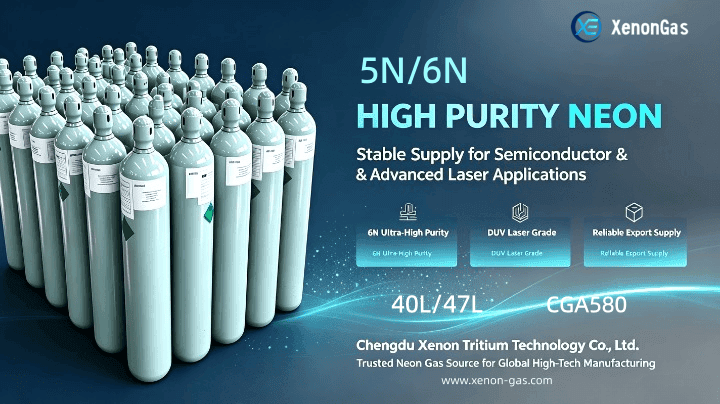
From standard 6N ultra-high purity neon gas to customized gas supply and technical support solutions, Chengdu Xenon Tritium Technology Co., Ltd. delivers stable, reliable neon supply chain solutions for global clients. Leveraging our mature ultra-high purity gas purification, full-process testing systems, and cross-border export service experience, we can provide stable supply of multiple specifications and high-quality neon gas, suitable for rigorous applications including semiconductor DUV lithography, advanced scientific research and high-end laser manufacturing. Whether it’s standardized cylinder gas supply or closed-loop recycling gas supply solutions, we can offer long-term stable support. To learn more about product specifications, impurity profiles and custom gas supply solutions, please visit our Neon Product Center.