Address
E02 No.509 Floor 5 Unit3 Building1 No.1700 Tianfu Avenue North Section High-tech district Chengdu City Pilot Free Trade Zone China(Sichuan)
Work Hours
Monday to Friday: 9AM - 6PM
Weekend: 10AM - 5PM
Address
E02 No.509 Floor 5 Unit3 Building1 No.1700 Tianfu Avenue North Section High-tech district Chengdu City Pilot Free Trade Zone China(Sichuan)
Work Hours
Monday to Friday: 9AM - 6PM
Weekend: 10AM - 5PM

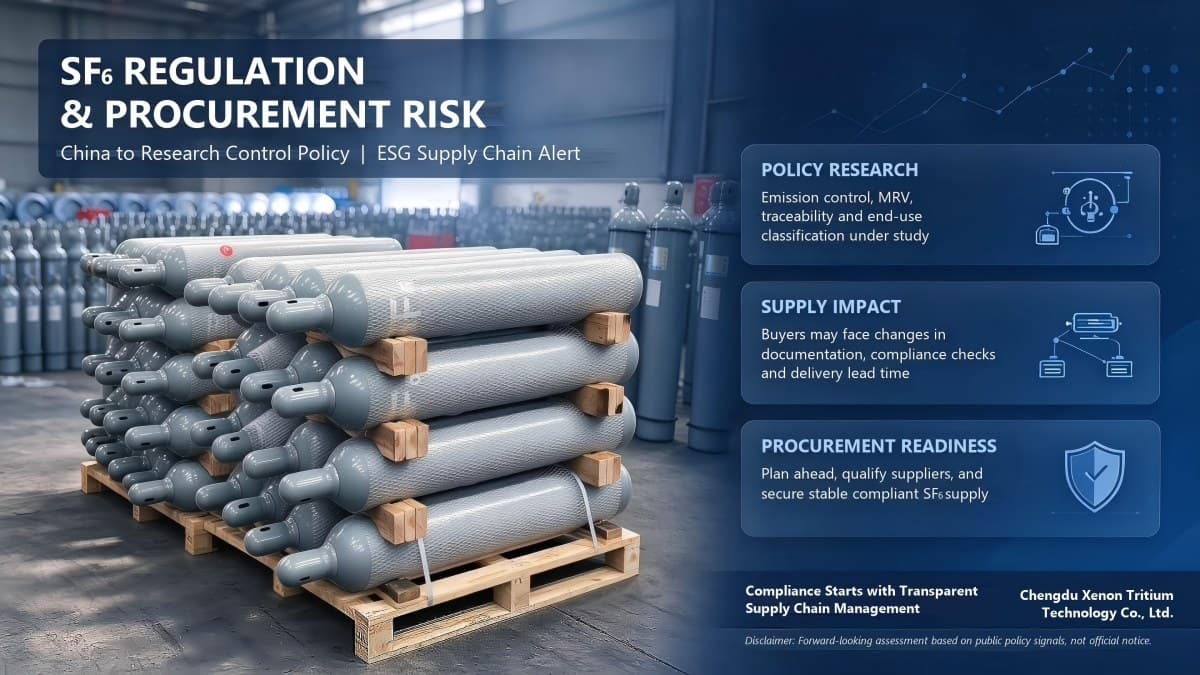
Sulfur hexafluoride (SF₆, GWP₁₀₀ = 24,300, IPCC AR6) is one of the most potent greenhouse gases. China has put SF₆ formally on its national GHG inventory, and the 15th Five-Year Plan (2026–2030) clearly targets strengthened control over non-CO₂ fluorinated greenhouse gases.
The core trend: export procedures remain relatively open today, but supply conditions and compliance rules are expected to tighten in the coming years. While there is no immediate export ban yet, the era of simple, unrestricted bulk shipments of virgin SF₆ is likely nearing its end.
Disclaimer: This is our industry forward-looking assessment based on public policy signals, not an official government notice. All formal regulations shall be subject to official releases from China MEE, MOFCOM, and Customs.
Executive Summary
Sulfur hexafluoride (SF₆, GWP₁₀₀ = 24,300, IPCC AR6) is one of the most potent greenhouse gases. China has put SF₆ formally on its national GHG inventory, and the 15th Five-Year Plan (2026–2030) clearly targets strengthened control over non-CO₂ fluorinated greenhouse gases.
The core trend: export procedures remain relatively open today, but supply conditions and compliance rules are expected to tighten in the coming years. While there is no immediate export ban yet, the era of simple, unrestricted bulk shipments of virgin SF₆ is likely nearing its end.
Combined with the EU F-Gas Regulation (EU 2024/573) phase-out roadmap, buyers across all regions are facing a narrowing window for stable, cost-effective SF₆ sourcing.
1.What is changing in China (Key regulatory timeline forecast) Currently, SF₆ is regulated as a hazardous chemical. There is no dedicated GHG-specific export quota system as of this writing. Shipments generally follow normal hazardous cargo inspection and customs declaration procedures.
However, policy evolution is underway step by step:
MRV & traceability systems are under development. Policy signals indicate that a mandatory monitoring, reporting, and verification (MRV) system will soon require producers and exporters to submit annual reports covering production volume, export quantity, cylinder serial numbers, end-use declaration, and estimated emission loss.
End-use classification management is under study. Industry discussions suggest that low-value, easily substitutable applications (such as magnesium die-casting) may face supply restrictions first. Priority supply is expected to be reserved for hard-to-replace sectors: semiconductor etching and cleaning, and critical high-voltage power grid maintenance.
Growth of virgin SF₆ output is expected to be gradually constrained under national GHG reduction targets. Authorities strongly push closed-loop recovery and recycled SF₆. Regenerated SF₆ quality can be verified against GB/T 12022-2025. Recycled gas will likely get preferential treatment, while virgin SF₆ may gradually become more restricted and costly.
Cross-border verification may tighten. In the medium term, cross-border shipments may introduce end-use verification procedures. Traders who cannot provide genuine final user information or valid recovery plans may face obstacles to export clearance.
Important takeaway: We do NOT expect an immediate total export ban. But the era of “no questions asked, fast bulk delivery” is likely coming to an end. Documentation burden, audit cycles, and compliance costs will keep rising. Certain end-uses may face additional documentary scrutiny or clearance delays.
These are analytical projections based on public policy signals, not confirmed regulatory timelines. Actual implementation is subject to official releases.
2.Global rule pressure is already squeezing demand options The EU F-Gas Regulation (2024/573) is the biggest hard constraint for European customers: Ban on new MV switchgear containing F-gases (including SF₆) ≤24 kV starting 2026. Further extension to 52 kV equipment by 2030. Non-reusable disposable cylinders are prohibited; importers must register, report, and organize gas take-back.
For buyers in the Middle East, Africa, South Asia, and Southeast Asia (Saudi Arabia, Nigeria, India, etc.): Local regulators have not yet set strict SF₆ limits. But your supply comes from China. If China tightens outbound traceability and end-use checks, your supply chain will be disrupted directly, regardless of your local laws.
Many customers assume they have plenty of time. In reality, most low-GWP alternative insulation gases are still expensive, with limited production capacity and incomplete field validation. Mass replacement of SF₆ in installed high-voltage grids will take 10+ years. Existing fleets will keep needing SF₆ for maintenance, refilling, and repair for a long time.
3.What this means for YOU as a buyer As a recent real-world reference for export policy risk: China implemented a temporary export ban on helium (Announcement No. 29 of 2026) in July this year. It serves as a clear signal that strategic specialty gas export rules can shift rapidly with little advance notice. Buyers should not assume that existing export permissions will remain unchanged indefinitely.
Stable, low-cost virgin SF₆ supply will become scarcer. Once the Chinese traceability and reporting system goes live, many small informal suppliers may exit the export market. Only companies with full cylinder tracking, MSDS, end-documentation, and recovery capabilities can keep shipping. Less competition generally means firmer pricing and longer lead times.
Approval delays may become common. Future shipments could require extra GHG declaration forms, end-user statements, and recovery commitment documents. Customs clearance and official audit cycles may get longer. Rush orders will be much harder to fulfil.
Application screening may limit your purchase options. If your end-use falls into restricted categories later, it may become more difficult to source SF₆, even if you are ready to pay.
Recycled SF₆ is an alternative, but capacity is limited. Recycled SF₆ meets international specs and qualifies under many green schemes. However, global recovery capacity is far smaller than virgin production and cannot fully replace market demand in the short run.
4.Our Recommendation for Your Procurement Plan Given the potential policy window and rising global regulatory risks, we advise evaluating your inventory buffer and considering framework arrangements based on your own operational continuity plan:
✅ Assess your medium-term demand and consider framework orders to secure allocation before potential restrictive rules take effect.
✅ Build safety stock for your installed power assets and semiconductor lines, as lead times and compliance overhead may increase.
✅ Avoid relying only on spot market purchases. Spot supplies are usually the first to be impacted when controls tighten.
✅ Prepare your end-use documents and cylinder return agreements in advance to avoid shipment hold-ups later.
✅ If you are evaluating low-GWP alternatives, treat them as a long-term roadmap — not a near-term replacement for your current SF₆ consumption.
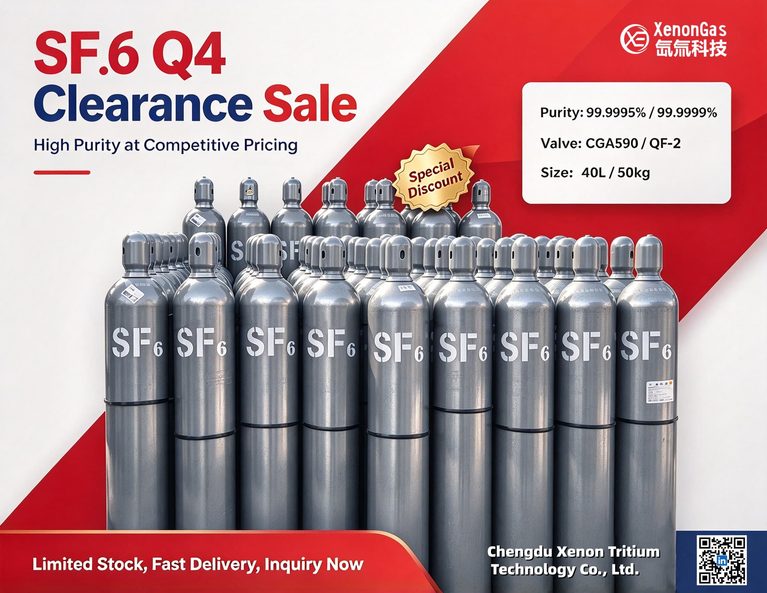
✨ Special Q4 Promotion Notice
The following commercial offer is provided independently for customers who have already assessed their procurement needs based on operational continuity.
We are running a limited-time Q4 SF₆ promotion for qualified buyers this quarter. Favorable pricing and reserved allocation are available for framework orders placed during this promotion period.
We maintain stable export allocation and full compliance packages (MSDS, test certificates, cylinder trace records, end-use statement templates) for qualified customers. Reach out to us to discuss volume reservation, promotional pricing, and delivery schedules.
Closing Remark
The window for low-documentation, unrestricted bulk SF₆ exports from China is narrowing. Early planning and secured volumes during our Q4 promotion are the best ways to protect your operation from potential supply disruptions.
#SF6 #SulfurHexafluoride #GreenhouseGas #FGas #SpecialtyGas #SupplyChainRisk #Compliance #ChengduXenonTritium