Address
E02 No.509 Floor 5 Unit3 Building1 No.1700 Tianfu Avenue North Section High-tech district Chengdu City Pilot Free Trade Zone China(Sichuan)
Work Hours
Monday to Friday: 9AM - 6PM
Weekend: 10AM - 5PM
Address
E02 No.509 Floor 5 Unit3 Building1 No.1700 Tianfu Avenue North Section High-tech district Chengdu City Pilot Free Trade Zone China(Sichuan)
Work Hours
Monday to Friday: 9AM - 6PM
Weekend: 10AM - 5PM


Since 2026, the global industrial logic surrounding nitrous oxide has been undergoing a fundamental shift. On one hand, demand continues to expand in essential sectors such as healthcare, semiconductors, and high-end food processing ; on the other hand, regulatory policies in various countries are rapidly tightening, carbon emission constraints are escalating, and controls on non-industrial uses are becoming more stringent. The previously relatively stable global supply system is transitioning to new rules based on "compliance first, precise allocation, and full-chain traceability."
Since 2026, the global industrial logic surrounding nitrous oxide has been undergoing a fundamental shift. On one hand, demand continues to expand in essential sectors such as healthcare, semiconductors, and high-end food processing ; on the other hand, regulatory policies in various countries are rapidly tightening, carbon emission constraints are escalating, and controls on non-industrial uses are becoming more stringent. The previously relatively stable global supply system is transitioning to new rules based on “compliance first, precise allocation, and full-chain traceability.”
For procurement, sales, and management decision-makers targeting the global market , the most critical challenge is no longer “securing sources of supply,” but rather—how to establish a stable supply system that combines cost advantages, compliance capabilities, and resilience against risks amidst multiple overlapping policies .
According to industry estimates, the global nitrous oxide market size was approximately US$48 billion in 2026, and is projected to grow to approximately US$79.1 billion by 2035, with a compound annual growth rate of 5.7%.
Policy changes are profoundly rewriting the underlying rules of global supply.
In this round of global regulatory upgrades, traditional high-emission production processes are being rapidly phased out, and low-carbon routes based on exhaust gas recovery and purification have become the preferred technology route for leading suppliers.
The differentiation of regional supply chains is currently the most noteworthy industry trend.
For multinational companies, relying solely on sourcing from a single region is no longer sufficient to meet diverse compliance requirements, and building a regionally adapted supply network is becoming a core issue for decision-makers.
In the new normal of increasingly stringent policies and a fragmented supply chain, high-quality suppliers with low-carbon processes, full-grade compliance, and cross-border delivery capabilities have become the core enablers for downstream enterprises to strengthen supply chain security. Leading supply solutions in the industry generally focus on low-carbon exhaust gas recovery and purification technology, addressing the current industry pain points of cost, compliance, and delivery through a multi-level product matrix, a global compliance layout, and full-chain traceability services.
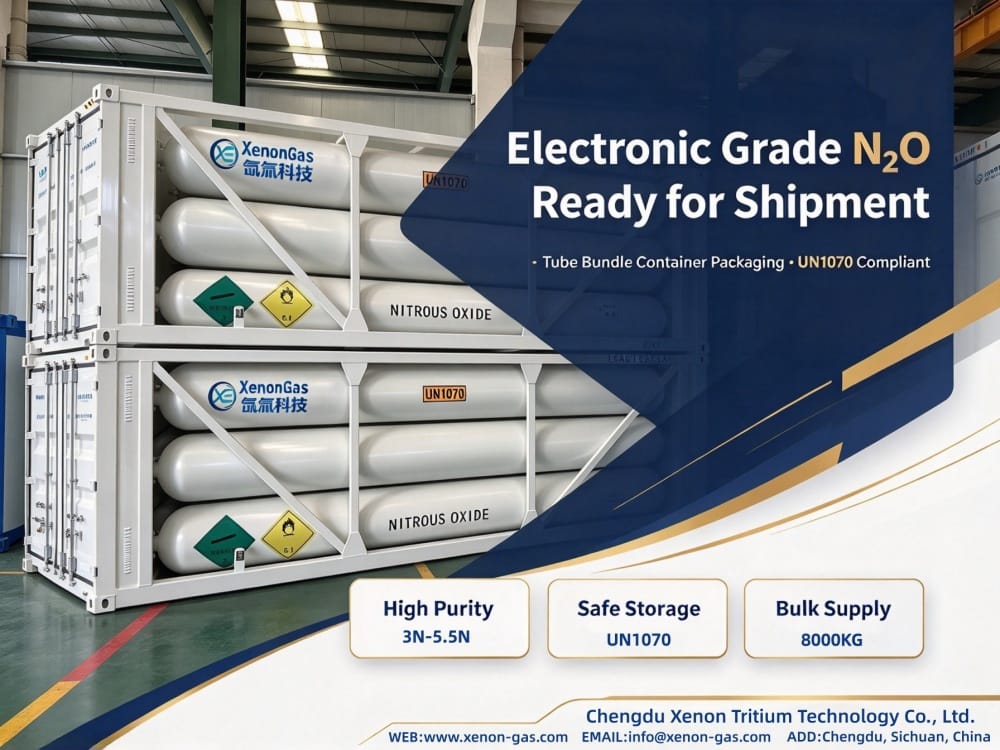
Leveraging a mature low-carbon R&D system in China, Chengdu Xenon Tritium Technology has established a comprehensive nitrous oxide supply system covering electronic, medical, and food grades. This system is pre-qualified to meet compliance requirements in multiple regions, including China, Southeast Asia, Europe, and the United States, and offers integrated services such as production traceability, carbon footprint accounting, and cross-border tank transportation . With its low-carbon processes, complete qualifications, and cross-border delivery capabilities, Chengdu Xenon Tritium Technology helps downstream customers achieve their core objectives of cost control, compliance, and supply chain stability amidst global policy fluctuations.
The global nitrous oxide market is currently in a window of opportunity where policy, demand, and technology are intertwined. The pace of carbon tariff implementation across regions, global electronic-grade gas standards, and China’s new domestic regulatory updates will all further alter the flow of supplies and warrant continued close monitoring.