Address
E02 No.509 Floor 5 Unit3 Building1 No.1700 Tianfu Avenue North Section High-tech district Chengdu City Pilot Free Trade Zone China(Sichuan)
Work Hours
Monday to Friday: 9AM - 6PM
Weekend: 10AM - 5PM
Address
E02 No.509 Floor 5 Unit3 Building1 No.1700 Tianfu Avenue North Section High-tech district Chengdu City Pilot Free Trade Zone China(Sichuan)
Work Hours
Monday to Friday: 9AM - 6PM
Weekend: 10AM - 5PM

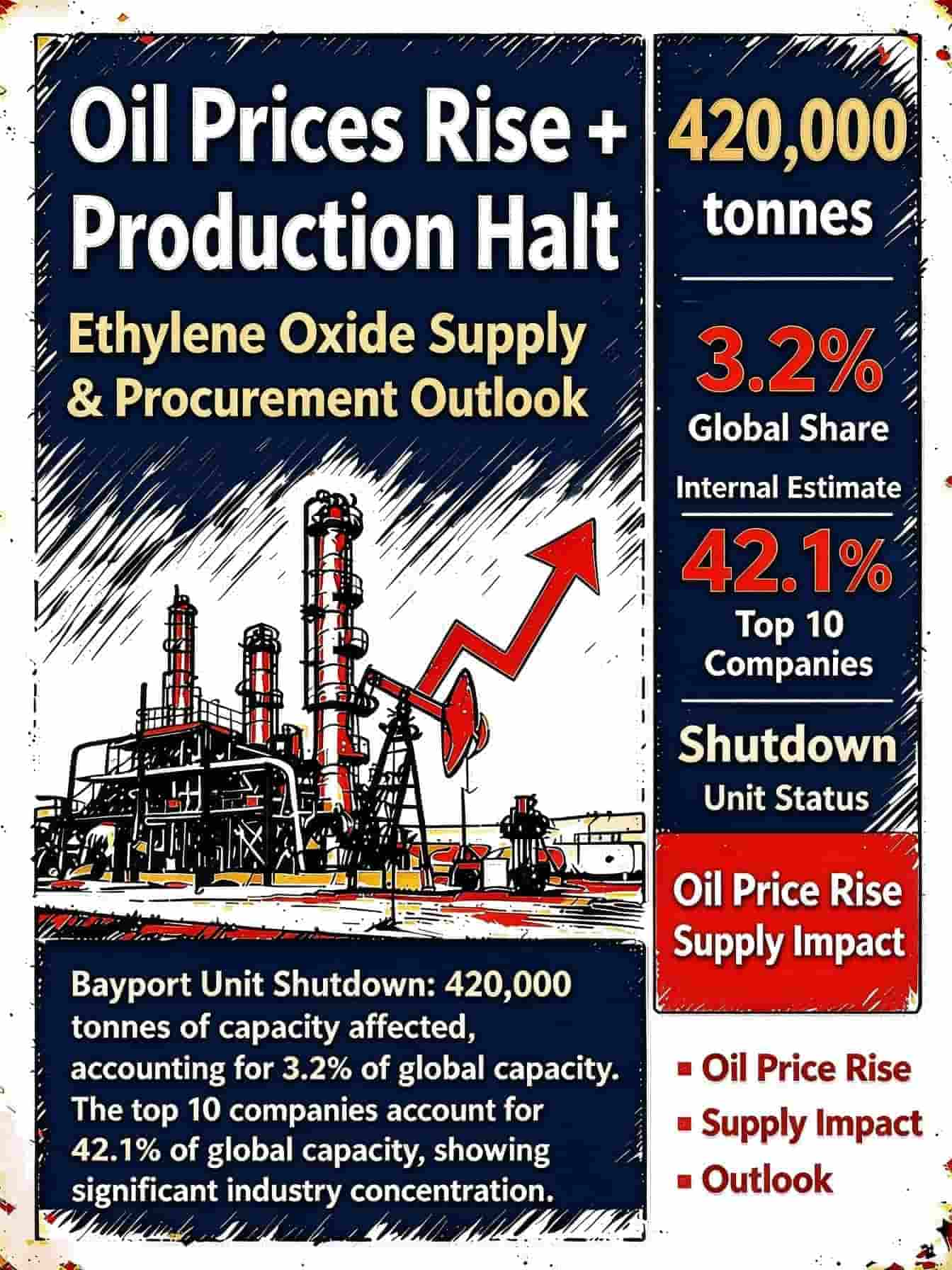
Since the second half of 2026, the global ethylene oxide market has been undergoing structural changes due to the combined effects of rising energy costs and a sharp decline in core production capacity. The continued rise in international oil prices has driven up raw material costs throughout the entire industry chain. Coupled with the unexpected shutdown of INEOS's 420,000-ton-per-year ethylene oxide plant in Bayport, Texas, the already weak global ethylene oxide supply and demand relationship has been rapidly disrupted. This change is spreading from North American production areas to other parts of the world, directly impacting the purchasing decisions of multiple downstream industries, including fine chemicals, semiconductor materials, new energy additives, and consumer chemicals.
Since the second half of 2026, the global ethylene oxide market has been undergoing structural changes due to the combined effects of rising energy costs and a sharp decline in core production capacity. The continued rise in international oil prices has driven up raw material costs throughout the entire industry chain. Coupled with the unexpected shutdown of INEOS’s 420,000-ton-per-year ethylene oxide plant in Bayport, Texas, the already weak global ethylene oxide supply and demand relationship has been rapidly disrupted. This change is spreading from North American production areas to other parts of the world, directly impacting the purchasing decisions of multiple downstream industries, including fine chemicals, semiconductor materials, new energy additives, and consumer chemicals.
The impact of INEOS’s production halt is not a reduction in the supply of a single product, but rather a coordinated reduction in production across the entire ethylene oxide supply chain.
Global ethylene oxide production capacity is highly concentrated. According to our internal capacity model (based on consolidated and equity capacity, which differs from rankings of individual entities reported by publicly available third parties), the top ten producers account for 42.1% of global capacity. Saudi Aramco accounts for approximately 8.9% on a consolidated basis, with Sinopec and Shell ranking second and third, respectively. It should be noted that leading producers listed as individual entities in publicly available market reports are often Dow, Sharq, Formosa, etc. The ranking differences mainly stem from different statistical methods and do not alter the structural characteristic of highly concentrated global capacity. Among these top ten producers, INEOS operates the Bepport complex, located at the epicenter of the current production disruption—a structural feature that amplifies the impact of a single plant shutdown on the market. Under this supply structure, unplanned shutdowns of a single major plant can easily be transmitted to downstream regions through global distribution and trading networks, thereby exacerbating market expectations of a supply gap.
The current rise in ethylene oxide prices is not a short-term fluctuation caused by a single event. The persistently high price of upstream crude oil has led to increased costs, which forms the fundamental support for this round of price increases.
The rapid changes in the supply chain landscape are fundamentally altering the purchasing habits of downstream industries that have developed over the past few years, with adjustments occurring globally in three directions:
Over the next 6-12 months, the global ethylene oxide market will generally enter a period of high volatility. The momentum of sharp price increases will gradually weaken, but it is unlikely to return to the previous low operating range.
Overall, the global ethylene oxide market has moved away from the loose supply environment of the past few years, and buyers need to develop more flexible supply chain strategies to adapt to the intense supply and demand game that will continue for a long time.