Address
E02 No.509 Floor 5 Unit3 Building1 No.1700 Tianfu Avenue North Section High-tech district Chengdu City Pilot Free Trade Zone China(Sichuan)
Work Hours
Monday to Friday: 9AM - 6PM
Weekend: 10AM - 5PM
Address
E02 No.509 Floor 5 Unit3 Building1 No.1700 Tianfu Avenue North Section High-tech district Chengdu City Pilot Free Trade Zone China(Sichuan)
Work Hours
Monday to Friday: 9AM - 6PM
Weekend: 10AM - 5PM


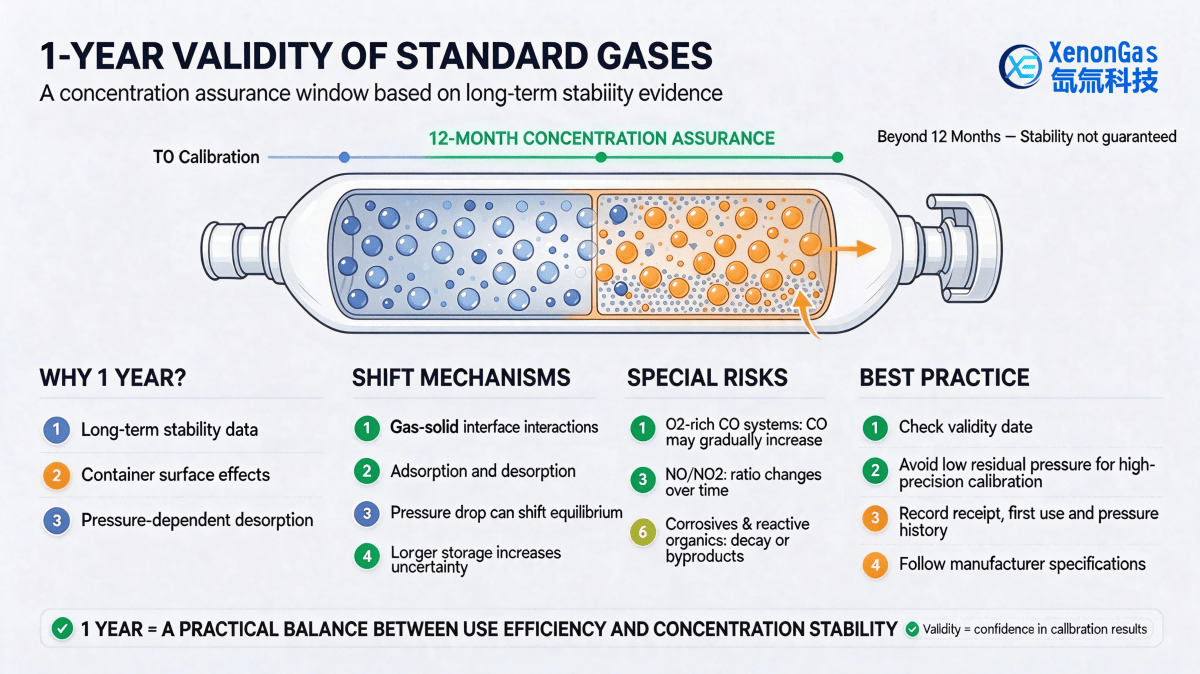
Within the global industrial gas supply chain, the standard shelf life for conventionally blended standard gases is set at one year. This is not an arbitrary industry convention, but a widely adopted practice established from extensive long‑term stability testing, container characterization studies, and observations on the chemical behavior of gas components across the globe. It is widely applicable to sectors including semiconductors, environmental monitoring and petrochemicals, which demand high accuracy for gas calibration.
Within the global industrial gas supply chain, the standard shelf life for conventionally blended standard gases is set at one year. This is not an arbitrary industry convention, but a widely adopted practice established from extensive long‑term stability testing, container characterization studies, and observations on the chemical behavior of gas components across the globe. It is widely applicable to sectors including semiconductors, environmental monitoring and petrochemicals, which demand high accuracy for gas calibration.
The expiry date essentially represents a “concentration guarantee window”: within the labelled one‑year period, the concentration deviation of every component in the cylinder is kept strictly within the permissible error band of the nominal value, satisfying compliance requirements for instrument calibration, process calibration and test traceability. Once this window expires, even if the cylinder remains unopened, the equilibrium at the internal gas‑solid interface may drift slowly over time. The manufacturer can no longer guarantee concentration performance, and the mixture may lose its value as a calibration reference.
For standard gases that use inert gases as the balance gas and feature stable chemical properties, the one‑year validity window is a safe interval validated by the global industry over extended testing.
▫️ Adsorption‑Desorption Dynamic Process At elevated pressure, gas molecules remain in prolonged contact with the cylinder inner wall. Even after multiple pre‑treatments including mirror polishing, acid washing, passivation and pre‑saturation conditioning, slow microscopic adsorption‑desorption processes take place. This is the root mechanism governing the long‑term stability of standard gas mixtures.
▫️ Concentration Deviation Pattern under Low Pressure As cylinder pressure gradually drops during use, trace constituents originally adsorbed within micropores on the metal inner wall desorb back into the gas phase and upset the original concentration equilibrium. This effect is greatly pronounced for low‑level standard gas mixtures. Even where initial preparation accuracy meets international standards, substantial concentration drift can arise with prolonged storage or excessively low residual pressure.
▫️ Industry‑wide consensus There is an industry‑wide consensus: once cylinder residual pressure falls too low (a residual pressure below 0.5 MPa is the common threshold for most high‑precision applications), continued use for high‑accuracy calibration is not advised, even if the cylinder is still within its stated one‑year validity period. This prevents measurement bias triggered by bulk desorption of inner‑wall constituents at low pressure and preserves consistency of calibration data.
For oxygen‑rich standard gas matrices, the long‑term behaviour of CO serves as a classic case impacting shelf life and represents a well‑recognised stability challenge across the industry.
▫️ Initial State of Adsorbed CO on the Inner Wall Cylinder inner walls are not perfectly inert. After prolonged exposure to the gas mixture, an ultra‑thin layer of adsorbed CO builds up. Under the initial high‑pressure equilibrium, this fraction of CO does not enter the gas phase in substantial quantities and exerts negligible short‑term influence on the nominal concentration.
▫️ Desorption effect under long‑term storage With extended storage, minor ambient temperature fluctuations and gradual shifts in internal pressure continuously shift the adsorption equilibrium toward desorption. CO previously immobilised on the inner wall slowly desorbs into the gas phase, causing the actual CO concentration in the cylinder to rise above the nominal value over time.
▫️ Magnified Effects of Low‑Concentration Systems Extensive industry testing demonstrates that CO concentration drift within oxygen‑rich standard gas mixtures stored beyond 18 months can exceed the permissible error band for routine analytical instrument calibration. This failure threshold occurs after the standard one‑year validity window, signalling higher stability‑management risk for oxygen‑rich CO matrices.
Constituents with differing chemical properties follow distinctly different failure pathways during long‑term storage. This explains why certain specialty standard gases carry an industry standard shelf life of only six months or even three months — and underscores the rationale for the one‑year shelf life applied to conventional mixtures.
▫️ Corrosive Active Components
Gases including hydrogen sulfide, chlorine and hydrogen chloride readily adsorb onto metal cylinder inner walls and react slowly with trace moisture and the substrate metal. Over time, their concentrations steadily decline. In severe cases, these species corrode the cylinder wall, permanently altering its internal surface state and further accelerating decomposition of constituents in gas mixtures filled at a later date.
▫️ NO‑NO₂ Reversible Interconversion in Nitrogen Oxide Systems
The NO/NO₂ system undergoes reversible interconversion. Even with high‑purity nitrogen as the balance gas, residual trace oxygen, water vapor and temperature fluctuations within the matrix continuously drive this conversion over time. The share of NO₂ within the NO standard mixture rises gradually, which invalidates the intended calibration ratio and renders the mixture unsuitable for precise calibration of nitrogen oxide analysers.
▫️ Highly reactive components
Certain low‑level unsaturated hydrocarbons and organic sulfides within standard gas mixtures can undergo slow polymerisation or isomerisation catalysed by the cylinder’s metal inner surface over long storage periods. This produces new species absent from the original formulation. Such changes directly compromise the accuracy of subsequent measurements and may even contaminate high‑precision analytical hardware.
Drawn from experience across the global industrial gas supply chain, the one‑year validity period for standard gases represents, at its core, a balance between operational usability and concentration stability. Beyond tracking the labelled one‑year expiry window on each cylinder, purchasing and end‑user teams should log the cylinder receipt date, date of first opening, and residual pressure trends to maintain a complete standard gas usage record. This practice maximises the reliability and traceability of all calibration data.